Saturday, May 31, 2014

Yellowstone


"Be it enacted...that the tract of land...lying near the headwaters of the Yellowstone river...is hereby reserved and withdrawn from settlement, occupancy, or sale under the laws of the United States, and dedicated and set apart as a public park ... for the benefit and enjoyment of the people".  - U.S. Senate, January, 1872


Yellowstone, the world's first national park, is over 3600 square miles in size - three times the size of Rhode Island.  Most people probably associate Yellowstone with Old Faithful and geysers, but the park is so much more diverse in its landscape.   

The best way to describe Yellowstone is to let the pictures speak for themselves:




Friday, May 30, 2014

First World Problems

So, we’re "camping” on this trip, but hardly what they’d call it 30 years ago.  

We spent last night at an RV park right in Yellowstone and had to make do without WiFi or television access.   We woke up on a sunny 34 degree morning, turned the furnace on, and were horrified to find that our single cup Keurig coffee maker wasn’t working.  

Squeaking by with only one bar of access on our cell phones, we called the 800 number for Keurig emergencies and learned that we should be using room-temperature water (hey, we’re camping with a refrigerator full of bottled water in our RV – where would we get room temp water?).  We did the only logical thing for people that are truly roughing it – we heated our water in the microwave before pouring it into the Keurig.   Problem solved with ingenuity, and with no dependence on technology!  

Ready for another day of life in the wilds...


The Beartooth Highway

Charles Kuralt called the 60-mile Beartooth Highway in Montana "the most beautiful drive in America", and it doesn’t disappoint.  Arriving as we did in late May, there was still plenty of snow on the ground at the higher elevations --- the high point on the road being at 10,947 feet.  The road starts in the town of Red Lodge and ends in Cooke City, just a couple of miles from the northeast entrance to Yellowstone National Park (more on Yellowstone at some later time when we have better WiFi access!)


We passed by snowmobilers getting ready to head out, and came upon the Twin Lakes Headwall, a ski slope with a small rope tow that the one guide book  describes as "where young ski racers...gather each summer ...its steep slopes pitched at a challenging 58 degree angle”.  


Gracie and Abby were happy to romp in the snow, and my biggest challenge was not to hyperventilate as John negotiated some of the switchbacks along the way.


Wednesday, May 28, 2014

Billings, Montana Tidbits

Today's driving brought us to Billings Montana, a city with several connections to Vermont.   The city of Billings was named after Frederick Billings, who was born in Vermont.  He was not from a wealthy family, but made his own fortune and eventually became president of the Northern Pacific Railroad -- a railroad that made its way through the village that became Billings Montana.  


Frederick's wife Julia Parmly Billings was the daughter of prominent New York City dentist Eleazar Parmly, one of four dentist brothers who were all born in Vermont.  (Obscure factoid - Eleazar's brother Levi Spear Parmly is considered to be the "father of dental floss").   

In any event, the Billings family donated $25,000 to the city of Billings in 1902 to build the Parmly Billings library; the structure still stands and is now the Western Heritage Center (www.ywhc.org/).

In the interest of full disclosure, many of you know that I work part time at the Billings Farm and Museum in Woodstock VT, so I couldn't resist posing with good old Frederick himself in front of the Heritage Center. 

A Note About Pictures

Note: Although the pictures I'm pasting in are small, if you click on any one of them, it will come up in full screen mode.

Tuesday, May 27, 2014

Motorcycles and Extraterrestrials

After five days of driving, today finally brought us to our general destination of Wyoming, Montana, Idaho, and  northern Utah.  We started the day at the western end of South Dakota in Rapid City, and headed northwest into Sturgis, the location of the (in)famous motorcycle rally that is held every August.   

As many as 600,000 show up during the course of the week-long event, in a town whose annual population is less than 7,000.  Storefronts and bars that are empty for most of the year come to life during that first week in August, and some residents even rent out their homes and leave town for the event.

File picture from a previous year's rally


There were no such crowds when we were there, and hardly any motorcycles - just a couple that appeared out of nowhere when I stopped to take a picture of an empty bar.  


Next year's event (August 2015) will be the 75th annual, and as many as 750,000 bikers are expected.

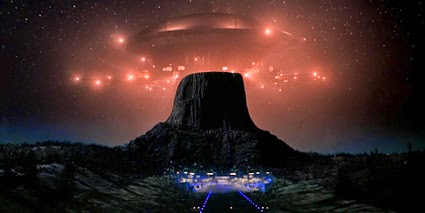
Next stop - Devil's Tower Wyoming, our country's first national monument, as declared by President Theodore Roosevelt in 1906.  


The tower is the result of magma rising up from the ground and the effects of erosion on it over the years, but I think I like the Native American explanation for its formation better: the story goes that the monolith rose up under the feet of seven Indian girls who were trying to escape from a bear; the bear's "claw marks" can still be seen on the sides of the Tower, but the girls were eventually raised so far into the sky that they formed the Seven Sisters constellation, also known as the Pleiades.  

No matter what you believe, I can see why the Tower sparked the imagination of director Steven Spielberg in his 1977 movie "Close Encounters of the Third Kind".


Monday, May 26, 2014

The World's Only Corn Palace

We stumbled upon the Corn Palace in Mitchell South Dakota quite by accident eight years ago, but this time we made sure to stop on our way along I-90.

The Palace was first built in 1892; the building's exterior quite literally became a way to display the area's bounty.  Each spring, the murals on the outside walls are re-"painted" using over a quarter of a million corn cobs as the medium.   The building serves as a type of civic center, hosting live performances as well as local high school and college basketball games.   

True to form for this part of the country, billboards promoting the Corn Palace start appearing on the highway hundreds of miles in advance.


The murals are made from corn.   This year, it's a little sparse as the Palace prepares for some renovations.


Oh, but as the ads say...."It's a-MAIZE-ing" and worth the stop!