Thursday, July 22, 2010

More Montana


According to the AAA Tour Book, the name Montana comes from the Spanish word for "mountainous" - a description that was obviously NOT bestowed by anyone coming into the state from the East. Today we reached the outskirts of Glacier National Park (pictures tomorrow), but most of the morning was characterized by dusty little plains towns, trains, and more wide open spaces.


The plains slowly turned into hills, and we came across yet another wind farm. No matter how many we've seen, they still fascinate us. The still camera can't capture their mvoement, but to me they've always looked like graceful and benign alien giants in a synchronized exercise class.

Wednesday, July 21, 2010

Montana


Planning to come back through North Dakota again on our way home in a few weeks, we bypassed Theodore Roosevelt National Park and the North Dakota Badlands for now, and opted instead to stay on U.S. 2 route through the northern North Dakota plains into Montana. Parts of route 2 loosely follow the Missouri River, so we thought it an appropriate time (and a way to break up the sameness of today’s scenery) to listen to “Undaunted Courage” on CD, tracing Lewis and Clark’s journey along the same river. Listening to the challenges they faced with disease, weather extremes, Indians, diminishing provisions, and difficult and uncertain terrain certainly put into perspective our complaints of having to walk the dogs in the rain, or of campgrounds lacking WiFi connectivity. Nevertheless, we find ourselves annoyed when campgrounds fall short of the descriptions we see in various camping guides (like the unmentioned proximity of tonight’s campground to the local railroad freight yards!).

On the bright side, we still prefer this mode of travel for a number of reasons – for one, being able to see how people live in the rest of the U.S., and also for the people we meet along the way: our neighbors in Williston, N.D. on Tuesday night included two men from California who are bicycling their way from Seattle to Bar Harbor, ME; tonight, we met a motorcyclist from Nova Scotia who was making his way to California and back in only four weeks!

Tuesday, July 20, 2010

North America Revolves Around Rugby


Rugby, North Dakota is the geographic center of North America.


West of Rugby, the northwestern part of North Dakota seems an endless stretch of canola (or maybe safflower?) fields, oil wells, and big sky.


Paul Bunyan


As we headed west Monday on U.S. Route 2, through miles of lakes and waterways, we drove through Grand Rapids, Minnesota, the birthplace and early home (now museum) of Judy Garland. Our lunch stop was in Bemidji, the “First City on the Mississippi”, located just a few miles from the river’s headwaters in Itasca State Park. Bemidji is a charming town on a lake of the same name, with a waterfront park that boasts an 18 foot statue of its “native son” Paul Bunyan, along with his blue ox “Babe”.

Perhaps it’s no coincidence that the state that lays claim to the giant lumberjack is also the state that elected Jessie Ventura as its leader. Take away Mr. Bunyan’s beard and dark head of hair and we think the resemblance to the former wrestling champ and governor speaks for itself!

"Highway 61 Revisited"


On Sunday, Route 61 took us along the western shore of Lake Superior from Thunder Bay to Duluth, Minnesota. Seeing a poster of Bob Dylan in Duluth, we had an ”aha!” moment as to the context of his 1965 “Highway 61…” album name. It also reminded us that Minnesota is indeed the state that produced Mr. Dylan (aka Robert Zimmerman), as well as the diverse likes of Garrison Keillor, Judy Garland, Walter Mondale, Hubert Humphrey, and Michele Bachmann.
Just south of the U.S.- Canada border, we visited Grand Portage National Monument (http://www.nps.gov/grpo/index.htm), the site of a footpath used by traders from Lake Superior to the Pigeon River back in the 17th-18th centuries. Faintly visible from the shore was Isle Royale National Park (http://www.nps.gov/isro/index.htm), a set of islands off the coast of Minnesota but belonging to Michigan.


To us, northern Minnesota has long been known for logging, but we didn’t realize that mining has played a large role in settling the area as well. The town of Twin Harbors, north of Duluth, is still a shipping port of iron ore from mines further north and west.
Duluth, with a population of 87,000, is less populous than Hartford, but is one of the worlds’ largest sea ports. What surprised us most about the city were its steep hills – for a state whose highest point is only 2300 feet, our climb from the ports and out of the city led us up some San Francisco- like streets to an elevation of 1400’ in a very short span.

Saturday, July 17, 2010

Gitche Gumee


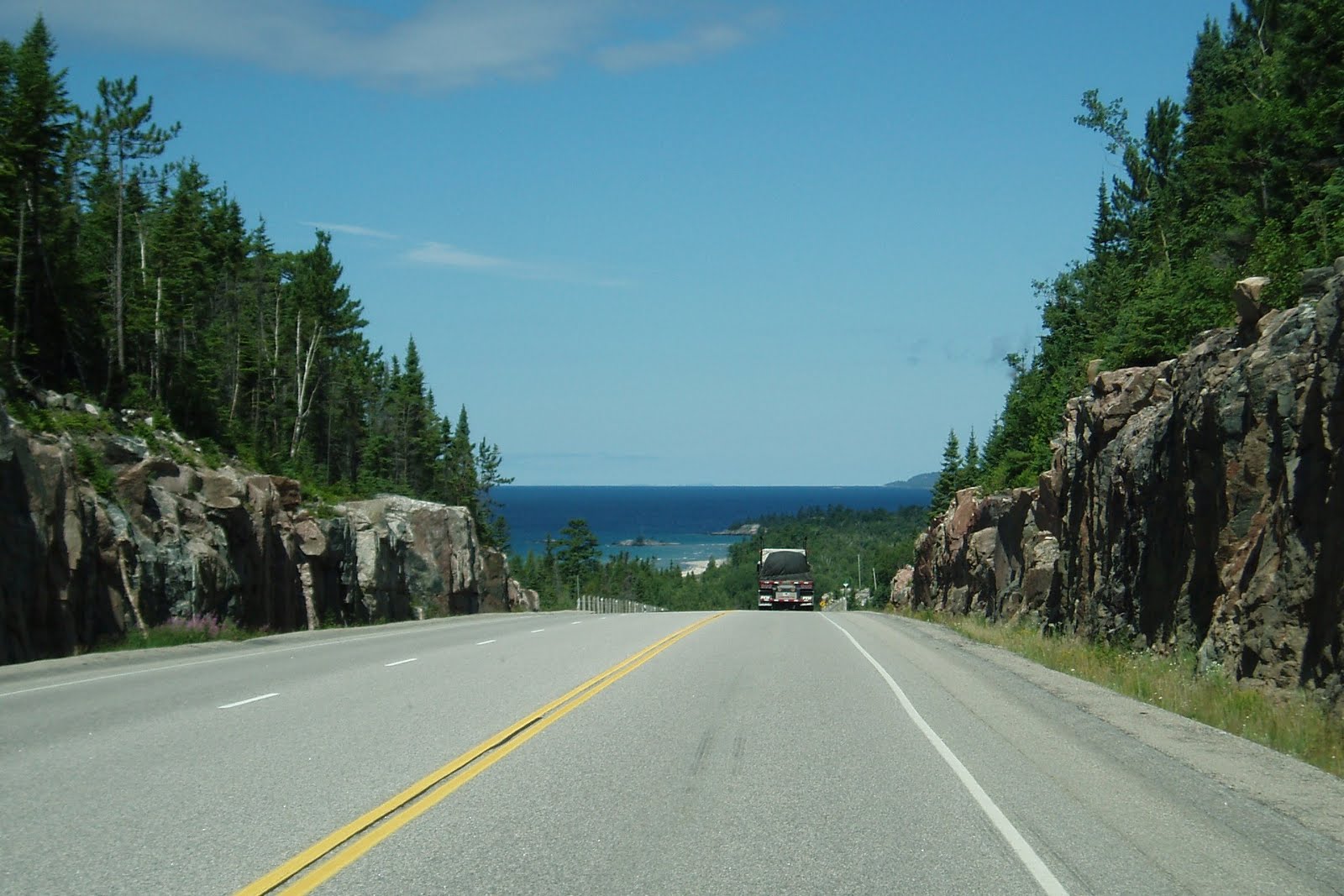
Today was a long but scenic day along the Canadian portion of the Lake Superior "Circle Tour" - the ruggedly beautiful 440 mile stretch from Sault Ste Marie to Thunder Bay Ontario.


The largest of the Great Lakes, Superior was named "Gitche Gumee" by the Ojibway and is the site of the 1975 wreck of the Edmund Fitzgerald (we learned that the Great lakes are thought to contain the greatest concentration of ship wrecks in the world). The surrounding landscape is dominated by small rivers and lakes, pine trees, rocky outcroppings, and lots of fireweed.

The town of Wawa on the eastern shore of Superior gets its name from the Ojibway word for wild geese - the Canada geese that stop at Wawa Lake during their annual migration*. In tribute, the town has a large statue of one such goose at its welcome center.


* Thankfully for the paint surface of our RV, our visit to Wawa today was not during migration season.

Thursday, July 15, 2010

Day 2

Our experience from prior extended trips has been that it's always the second day of our travels that we discover the things we've forgotten to pack. The first time, I believe it was extra bottled water; last year, it was peanutbutter - both easy to remedy. This year, it's my laptop power cord - more specifically, the apparently impossible to match adapter for a six to seven year old Dell Inspiron 5100. A stop at a suburban Ottawa Staples and another Radio Shack-like store produced no matches, and we very quickly discounted the idea of driving the 270 miles back home, considering our MPG rate. Fortunately, we've got John's laptop too so my new challenge will be to try to appropriate some snippets of time to upload pictures and post to this blog. (I have to admit, though, that I started to consider the benefits of travelling completely PC-less!).


OTTAWA


We visited the Canadian capital city about ten years ago and were impressed with its beauty, cleanliness, and parks, so we took a quick drive through before heading west on to North Bay.